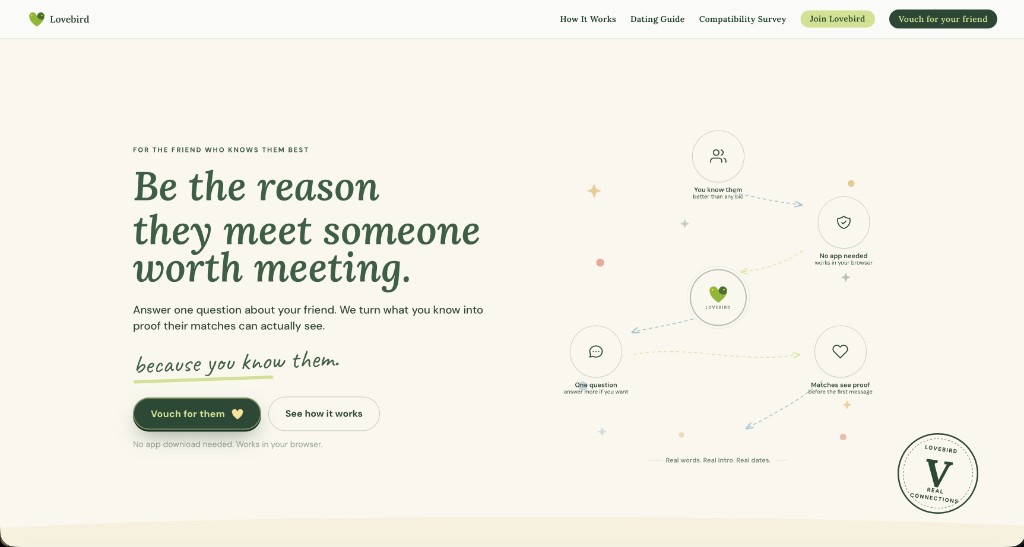
Every product has moments where something clicks for the user: the first time the thing works exactly as promised, the moment a stranger becomes a real connection. For Lovebird, an intentional dating app built around trust and genuine human connection, those moments deserve to be marked with something real.
The idea was straightforward: when a user gets their first vouch, or when a friend steps up to pitch someone they believe in, Lovebird wanted to mark both sides of that moment with a physical gift. A tangible surprise for the person being vouched and the person doing the vouching. Something that made the moment feel significant and gave both of them something to carry the experience into the world.
The execution had one hard constraint: Lovebird could not ask users for their home address. And they could not add a credit card collection step to the flow.
That combination is what brought them to Lumi.
Why Privacy Is Non-Negotiable for Lovebird
Lovebird is a dating app, and dating apps sit at the intersection of personal vulnerability and public trust. Users are sharing real information about who they are and what they are looking for. The app's entire value proposition is built on trust: the vouching system, the real-name endorsements, the signal that the people in your network are standing behind your character.
Asking a user to hand over their home address to receive a gift would undercut that trust entirely. It adds a data collection step that feels out of place in the middle of a personal experience. It creates a liability that a lean, privacy-focused team does not want to manage. And for many users, especially those who are cautious about sharing personal information early in an online relationship, it would simply be a reason to skip the moment.
The same logic applies to payment. Lovebird wanted to be able to send gifts to users as a product decision, not a purchase decision. Asking users to enter a credit card to receive something the app is giving them breaks the surprise. It turns an aha moment into a checkout flow.
The core requirement was simple and non-negotiable: both the user being pitched and the friend doing the pitching receive their gift. Lovebird does not collect the data from either of them.
How Lumi Solves It
Lumi's architecture is built around a model where the sender and the platform never need to see or store the recipient's address. When a Lovebird user is sent a gift, Lumi handles the address collection directly with the recipient through a private, Lumi-hosted flow. The user provides their details to Lumi. Lovebird never sees them. The gift ships.
The same applies to billing. Lovebird handles the commercial relationship with Lumi on the platform side. The user does not enter a credit card. They simply receive the gift.
For a privacy-first product, this is the only model that makes sense. There is no compromise: the user experience stays clean, no sensitive data passes through Lovebird's systems, and the aha moment lands as intended.
The Pitch-Your-Friend Feature and the Gift That Follows
When a Lovebird user signs up, they can invite people from their life to vouch for them on Lovebird: a short personal endorsement that appears on the profile alongside the endorser's name and their relationship to the user.
It is a fundamentally different kind of signal than a self-written bio. Real people, with names and relationships attached, are saying: this person is who they say they are.
When a pitch comes in and is accepted, that is exactly the kind of moment Lovebird wanted to mark with a physical gift. And it goes both ways. The person being pitched gets a personalized email with their custom QR code and a link to claim the Lovebird pitch gift tote bag. The friend who pitched them gets their own gift too, a personalized design reflecting the endorsement they submitted. Lumi fulfills both, without Lovebird touching a single address or card number from either person.
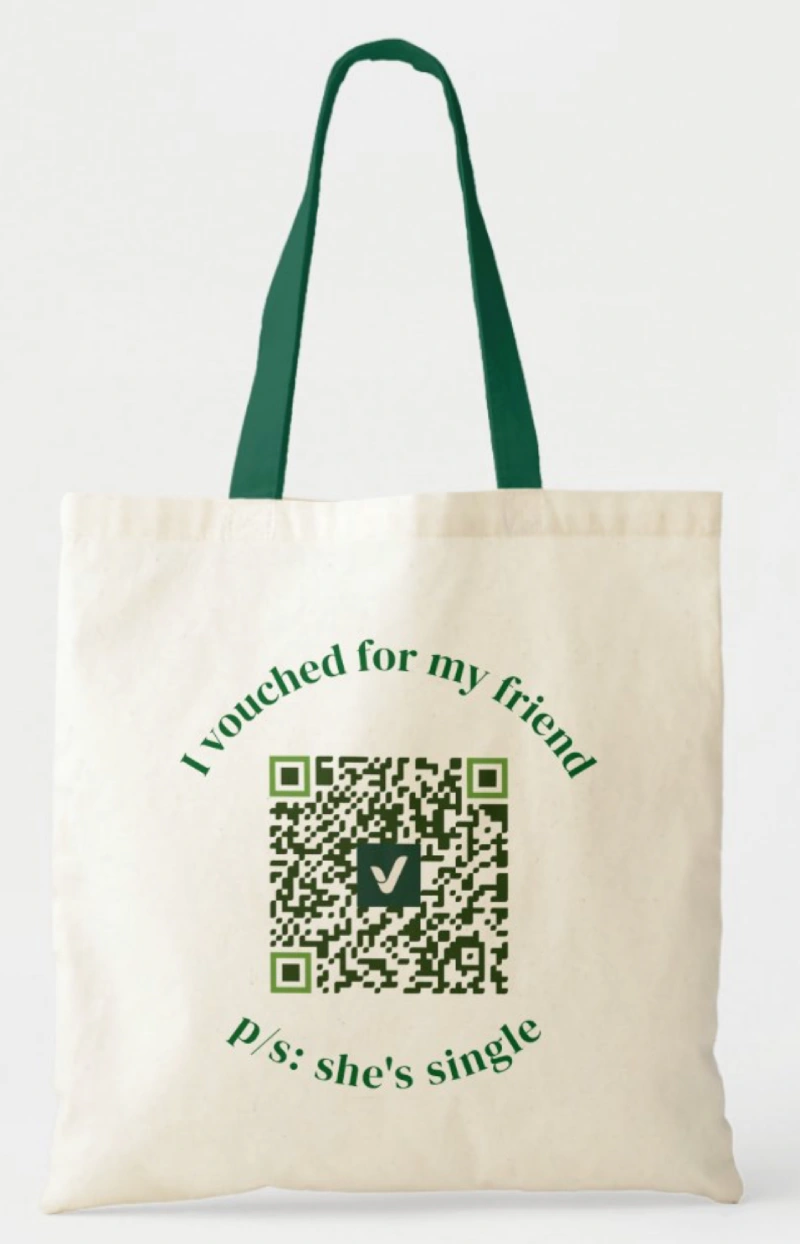
The tote bag is not swag. It is a piece of the Lovebird identity that both the dater and their endorser can carry into the world: to events, on commutes, at social gatherings where the whole point is to be open to an introduction. It is a shared artifact from a moment that mattered to both of them.
If you are curious how gifting builds trust in B2B relationship contexts too, read our piece on contact marketing and strategic gifting. For help crafting the message that accompanies any gift, our guide on gift note messages for every occasion has ready-to-use examples, and our guide on writing meaningful gift messages covers the framework behind them.
What the Integration Actually Looks Like
Jenny is Head of Engineering at Lovebird. Her team is small, and they needed the integration to be fast to ship and low-maintenance to run. The privacy model had to hold without adding infrastructure complexity on Lovebird's side.
Lumi's Business Automation platform handles everything after the trigger. Jenny's team decides when a gifting moment fires. Lumi handles the address collection, fulfillment, production, and shipping. One API call kicks off the full flow: the personalized email, the QR code rendering, and if the user claims the gift, the physical order. No separate vendors, no address storage on Lovebird's servers, no credit card step in the user journey.
Webhooks push delivery status back to Lovebird in real time, so the app can surface confirmation to users without any polling.
Jenny moved from first API call to a working integration in a matter of days.
Lumi's API was genuinely the smoothest integration we have shipped. The documentation is accurate, the endpoint does what it says, and the support team responded quickly when we had questions. For a team our size, that matters.
— Jenny, Head of Engineering, Lovebird
Why Gifting Works in Dating
There is something specific that physical gifts do in the context of new relationships that digital interactions cannot replicate. They signal that a moment mattered enough to mark it with something real. They create a memory that outlasts a notification.
For intentional daters, people who are showing up seriously and looking for a real connection, that kind of signal carries weight. The tote bag that shows up after your first vouch says: you took a step, and the app noticed.
Most meaningful connections start through shared social networks. A friend makes an introduction. A colleague brings a partner to an event. A family member mentions someone they think you should meet. Lovebird is designed to support those patterns, and the physical gifting layer is part of that same philosophy: meeting people in the real world, not just on a screen.
What to Expect at Launch
The feature is almost here. Jenny has finished the integration, and Lovebird is putting the final touches on the product experience before it opens to users.
When it goes live, both the user being pitched and the friend who pitched them will receive their personalized gift by email and can claim it through Lumi's fulfillment layer, without either of them providing their address to Lovebird or entering a payment method. We will post an update when it launches.
In the meantime, you can explore Lovebird and learn more about how the intentional dating app works.
Build Gifting Into Your Product
If your product has moments worth marking with something physical, and you cannot or do not want to collect user addresses or payment details, Lumi's model is built for exactly that.
Whether you are building in consumer social, loyalty programs, HR tech, or B2B relationship tools, the integration is fast to ship and handles the sensitive data so you do not have to.
Talk to our team about what you are building.
Frequently Asked Questions
Can you send gifts without asking for an address?
Yes. Lumi's model is specifically designed for this. Instead of the platform collecting the recipient's address, Lumi handles it directly through a private, Lumi-hosted flow. The recipient shares their delivery details with Lumi only. Lovebird never sees or stores the address, which means no new data liability for the platform and no intrusive request disrupting the user experience.
Do users need to enter a credit card to receive a Lovebird gift?
No. Lovebird handles the commercial relationship with Lumi on the platform side. The user simply receives a gift link and claims it. There is no checkout step, no card entry, and no payment friction in the user experience.
What is Lovebird's pitch-your-friend feature?
Pitch your friend is Lovebird's endorsement system, where friends, family members, and colleagues submit personal pitches for a user's dating profile. These endorsements appear publicly with the endorser's name and relationship to the user. When a pitch is accepted, Lumi delivers a physical gift to mark the moment.
What is the Lovebird pitch gift tote bag?
The pitch gift tote bag is a branded physical gift that Lovebird sends to users when a key moment happens in their profile journey. It is fulfilled by Lumi end-to-end: the user receives a personalized email with a claim link, and Lumi handles production, address collection, and delivery. The bag includes the user's custom QR code, which links to their vouched profile.
Has the Lovebird gifting feature launched yet?
Almost. The engineering integration is complete, and Lovebird is in the final stretch before opening it to users. We will post an update here the moment it goes live.
Can other apps use Lumi to send gifts without collecting user data?
Yes. The same privacy-preserving model that Lovebird is using is available to any platform. Lumi's Business Automation platform handles address collection, fulfillment, and delivery without the integrating platform needing to store or process user addresses. You can also explore one-off gifting at send-appreciation.